
What can you turn into a digital product?
Look for the part of your work that follows a clear method: a preparation checklist, a planning exercise, a set of instructions or a short sequence of lessons. A product makes that method understandable without you having to explain every step live.
Your value comes from choosing the right problem and teaching it well. A long PDF is not automatically useful, and an AI draft is not automatically ready to sell. The buyer needs an outcome they can recognize, examples they can follow and a clear view of what is outside the product's scope.
| Format | Best suited to | Include |
|---|---|---|
| Guide or ebook | Explaining a repeatable method | Clear steps, a worked example and useful reference material |
| Workbook | Helping a buyer make decisions or draft a plan | Short teaching, exercises, response space and self-checks |
| Editable template | Giving the buyer a reusable starting document | The working file, instructions and a completed example |
| Written mini course | Teaching one skill through a linked sequence | Lessons, examples, practice and a final task |
Thinkific's guide to coaching products covers several ways to package coaching knowledge. Here, the focus is on written products with a specific task and a practical first test. For a format decision in more depth, read ebook versus online course.
12 digital product ideas for coaches and consultants
These are original planning ideas, not verified best sellers or customer case studies. Adapt an idea to your expertise and intended buyer. The first test checks usefulness and interest; it does not establish demand for every version of the product.
1. Interview-story workbook
Who it helps: A career coach's clients who struggle to explain their experience in interviews.
What to include: A method for choosing relevant examples, one completed fictional story, prompts for three stories and a fact-check checklist. Deliver a workbook PDF with space to write.
First test: Ask a suitable reader to draft one story from their own experience. Record which prompts need explanation; do not treat a better draft as proof of a job offer.
2. Feedback-conversation guide
Who it helps: A leadership coach's clients preparing for a routine workplace feedback conversation.
What to include: A preparation method, a neutral worked example, an observation-versus-judgment check and a follow-up note. Keep the scope to communication practice, not employment or legal advice.
First test: Have a reader turn a fictional situation into a conversation plan. Check whether they can separate observed behavior from assumptions.
3. Weekly-priorities workbook
Who it helps: A productivity coach's clients who have a task list but no realistic plan for the week.
What to include: Prompts to list fixed commitments, choose a few priorities, reserve time and review the plan. Include one completed week with its constraints clearly stated.
First test: Ask readers to plan an actual week, then report what they changed. Use their experience to improve the prompts rather than promise hours saved.
4. First-offer decision mini course
Who it helps: A business coach's clients choosing which small service offer to test first.
What to include: Short written lessons on choosing a buyer, defining one deliverable, setting boundaries and planning a demand test. End with a one-page offer brief, not a promise of sales.
First test: Let a potential buyer complete the brief. Check whether another reader can explain who the offer helps and what it includes.
5. Delegation-brief template
Who it helps: A management consultant's clients who hand over tasks without explaining the expected result.
What to include: An editable Word structure for the task, owner, inputs, agreed date and review criteria, plus a completed fictional brief and instructions. Test the actual Word file before calling it editable.
First test: Give two people a sample task and the template. Check whether the receiver can identify the result, missing inputs and next review.
6. Client-kickoff guide
Who it helps: A freelance consultant's clients or peers who need a clearer start to a project.
What to include: A guide to gathering a brief, checking inputs, preparing a kickoff agenda and recording decisions. Put a worked agenda and a preparation checklist inside the delivered guide.
First test: Ask a representative reader to prepare an agenda from a supplied fictional brief. Note any questions the guide leaves unanswered.
7. Content-brief template
Who it helps: A marketing consultant's clients who send writers vague requests for posts or articles.
What to include: An editable Word brief covering reader, purpose, verified facts, key points, source material and next action. Add an annotated example that avoids invented customer claims.
First test: Ask someone to brief a real piece of content, then have a writer identify what is still missing before drafting.
8. Process-mapping guide
Who it helps: An operations consultant's clients who need to understand one routine business process.
What to include: A plain-language guide to inputs, steps, handoffs and exceptions, with one worked process and a blank mapping exercise. Teach one process at a time.
First test: Ask a reader to map a routine task and let a teammate follow it. Record unclear handoffs or steps that depend on hidden knowledge.
9. Discovery-call preparation worksheet
Who it helps: A sales consultant's clients preparing for a conversation with a prospect who has agreed to speak.
What to include: Prompts for known facts, open questions, fit criteria and a useful next step. Include a fictional preparation sheet and a reminder to avoid collecting unnecessary personal details.
First test: Have a reader prepare from a sample inquiry. Check whether the questions explore fit instead of assuming the prospect needs the offer.
10. Run a focused meeting mini course
Who it helps: A facilitator's clients who need a repeatable way to plan and close a short team meeting.
What to include: Written lessons on purpose, agenda, preparation, decisions and follow-up. The final task is an agenda and decision record made from supplied facts.
First test: Try the instructions with a small willing team. Review the agenda and recorded actions, without treating attendance as evidence of a better business result.
11. Website-project brief checklist
Who it helps: A service-business consultant's prospective clients who are about to request website work.
What to include: A free PDF checklist covering intended visitors, page purpose, existing content, assets, approvals and questions for the supplier. Offer an optional relevant next step.
First test: Ask business owners to use it before discussing a brief. Record whether it helps them ask clearer questions; a download alone is not a qualified lead.
12. Customer-FAQ planning guide
Who it helps: A small-business consultant's clients who repeatedly answer the same questions by email.
What to include: A method for grouping common questions, writing answers from verified business facts and choosing where to publish them. Include a fictional question-to-answer example and a review checklist.
First test: Ask a reader to draft three answers from their own confirmed policies. Check clarity and accuracy before publishing them to customers.
Start with the format you can teach and deliver reliably. Our workbook guide, template guide and mini-course guide cover the next steps for each format.
Choose one idea using evidence from your work
Compare three candidates before writing the whole product. For each one, name the buyer, the repeated problem, the finished output and the evidence that someone wants help. Keep the source of that evidence clear: a repeated client question is different from a compliment on a social post or a completed paid purchase.
The U.S. Small Business Administration's market-research guidance recommends checking demand, competing alternatives and what customers pay for them. It also describes direct research through surveys and interviews. Apply that to your specific audience rather than assuming a general market trend proves your offer will sell.
- I understand this problem from relevant experience and can explain my method clearly.
- A specific buyer has described the problem or shown useful interest in solving it.
- The buyer can complete the promised task with the material and support included.
- I have permission to use the source material and examples.
- I can reach suitable people through one relevant, permitted channel.
If a task needs your personal judgment every time, narrow the product to preparation or practice. If rights to a client document are unclear, resolve that before using it. Removing names does not automatically make confidential material suitable for sale.
Next, show a representative sample to suitable people. Ask them to try a task, explain what they expected and describe what they would use instead. Test willingness to pay separately from whether they liked the sample. Use our validation guide to record those observations.
Three worked examples: a workbook, a course and a free guide
The following offers are fictional plans. Their prices are proposals for testing, not market averages, completed launches or revenue results.
Example 1: a career coach's interview-story workbook
Buyer and result: A professional preparing for interviews will draft three truthful examples from their own experience. The product helps organize an answer; it does not promise an interview, job or salary increase.
Delivered file: One printable PDF containing a method, one worked fictional example, three story-planning exercises and a final check. No personal review, editable Word file or extra downloads are included in this example offer.
Worked story structure:
Situation: a small team was missing steps when handing over website work.
My action: I wrote a handoff checklist and asked teammates to review the steps.
Observed result: the team used the checklist at its next handoff.
What I can support: the checklist and that observed use. I cannot add an invented percentage improvement or claim I managed the whole project.
Each exercise asks the buyer to choose an event, separate their action from the team's work, write an observed result and remove claims they cannot support. A self-check asks whether another reader can identify the situation, personal contribution and evidence.
Proposed offer: $19 USD paid once for the PDF. First, ask representative readers to draft one story and record where they need help. Test the price only with a clear description of the complete file and its limits.
Example 2: an operations consultant's written mini course
Buyer and result: A small-team manager will prepare an agenda and decision record for one routine meeting. The course teaches a repeatable planning task rather than promising better team performance.
Delivered material: Five written lessons, one consistent fictional team brief, practice within each lesson and a final self-check. The example offer selects a PDF download alongside the written-course reader. It does not include video, graded assessment, certificates or a live session.
- Define the meeting's purpose and the decision needed.
- Choose the necessary attendees and preparation inputs.
- Build an agenda around the decision.
- Record decisions, owners and agreed next steps.
- Review the agenda and follow-up record against the brief.
For a fictional design team, the decision is which homepage draft to develop next. The supplied brief names two drafts and says the final photos are still missing. The worked answer keeps that missing input visible and records no final approval that the brief does not contain. Teach each step before asking the learner to apply it.
Proposed offer: $39 USD paid once. Let a suitable reader try the final task and compare it with the self-check. Our five-lesson mini-course guide shows the teaching pattern in more detail.
Example 3: a service-business consultant's free website-brief checklist
Reader and result: An owner preparing to hire a website supplier will identify the main visitor, page purpose, available content, missing assets and questions to resolve.
Delivered file: One free PDF checklist with a completed fictional page brief and a blank preparation section. Its optional next step is a brief-review inquiry through the consultant's real contact page. That destination must be supplied and tested before publication.
For the fictional Cedar Studio example, the page's job is to explain its introductory workshop and point visitors to current booking details. The blank section asks the owner to identify the equivalent facts for their own business, mark unknowns and list the assets they still need. It does not invent a booking price or available dates.
First test: Ask willing business owners to use the checklist before a brief discussion. Record whether it helps them identify missing inputs. If you collect contacts, separate resource delivery from permission for marketing. A download is not a qualified inquiry; a useful inquiry is not yet a paid client. See the lead-magnet guide for the resource and follow-up path.
Turn your method into a product in Genesize
Use your experience as the source and AI as a drafting aid. These steps were checked against the implementation on October 22, 2026.
- Choose the purpose. In Create product, review Product purpose: Sell a digital product, Free resource to attract leads, or Educate clients or customers. Match it to the actual goal.
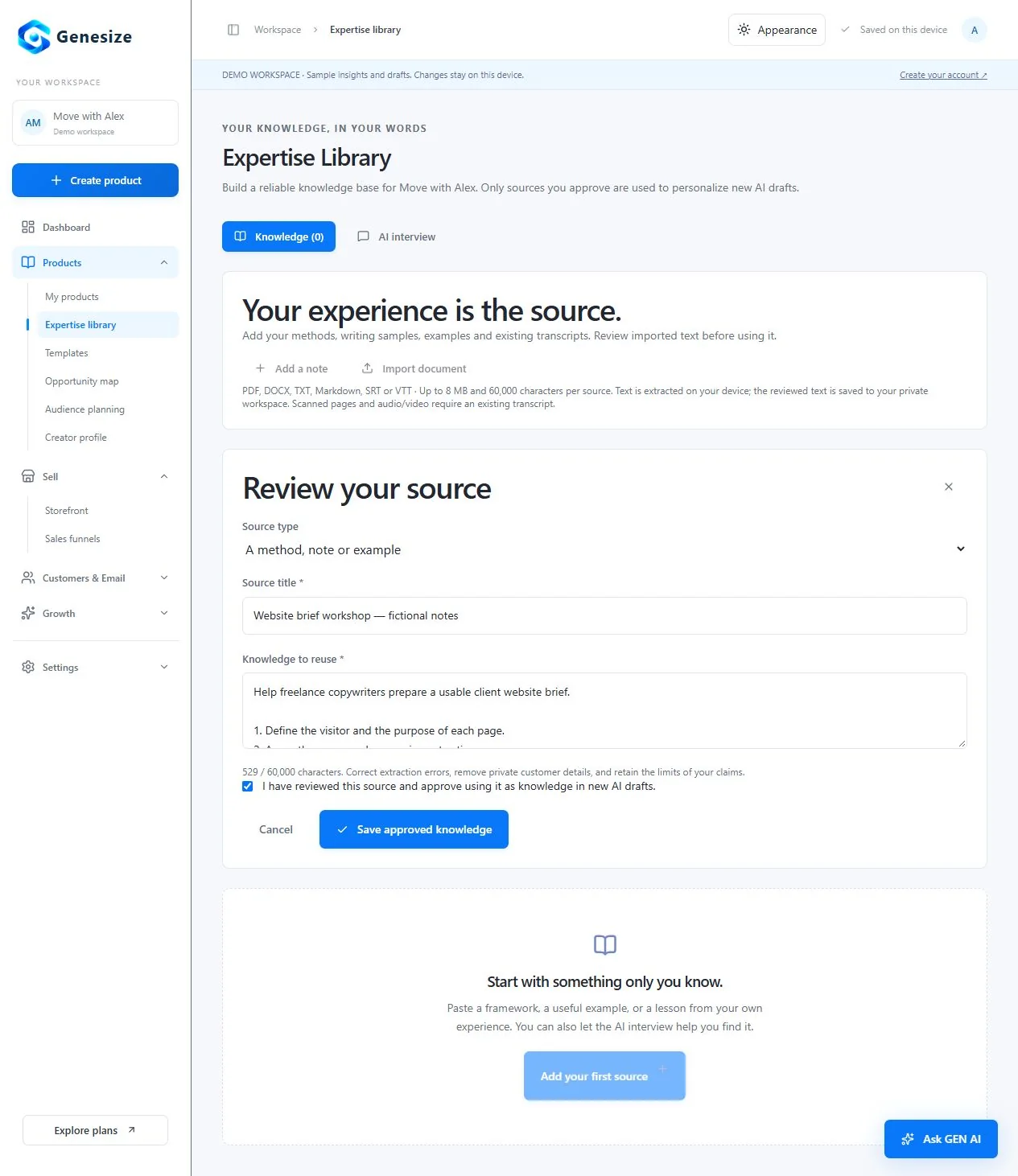
- Prepare approved knowledge. Add your own notes, methods and permitted examples in the Expertise Library. Review imported text, remove private details and approve only material you want used in new drafts.
- Write the brief. Name the buyer, problem, finished output, format, included support and exclusions. For a free resource, supply a real optional contact destination rather than asking AI to invent one.
- Review structure and draft. Choose the relevant product format and inspect the credit quote before generation. Check teaching order, repeated facts, exercises and scope. Edit the draft until a reader can use it.
- Inspect Design & exports. Open the actual selected PDF or Word file. Test working space, links, editing and the claimed file behavior. A standard PDF is not automatically fillable.
- Review the offer and delivery. Inspect the Store listing or funnel and use Buyer preview to compare the Saved draft with any Published edition. Confirm which saved file the buyer will receive.
Genesize creates written course materials. It does not currently provide video hosting, automatically graded quizzes, certificates or live communities. Buyers can mark written lessons complete manually and resume progress, but a completion tick does not prove a learning result. Customer lists and email tools are included in Creator and Business, with sending limits.
When selling a workbook or template, inspect the exact delivered asset. A separately exported fillable workbook is not automatically an extra file in the Store offer. Do not promise a multi-file bundle, editable spreadsheet or extra client service unless you have actually prepared and connected that delivery.
Price the result, describe the limits and test delivery
Choose a price using the buyer's problem, alternatives, actual contents and the time or support you include. Separate a product price from your coaching-session fee. A self-guided workbook and a personally reviewed plan are different offers with different costs.
The example $19 workbook and $39 course are possible prices to test. They are not verified price bands. Ten $19 purchases would be $190 gross before payment fees, refunds, taxes, software and support costs. That calculation does not predict ten buyers. Use the pricing guide to work through costs and a practical test.
Make the offer clear before sending people to it
Show the intended reader, useful task, contents, sample, format, price and support. State what is excluded. Use real feedback only when it is genuine and you have permission to publish it. Avoid turning a hypothetical example or a reader's compliment into a success story.
For paid offers, complete the supported payment setup and appropriate sandbox purchase-and-delivery checks. A private buyer preview disables checkout and forms; it does not prove a payment or receipt email worked. Check the selected saved edition, actual download and the support route for someone who loses access.
Start with one relevant route to buyers: an opt-in list, an agreed partner introduction, a permitted professional community or a useful public article. Use your sales page to explain one offer, and the launch checklist to check the complete path before wider promotion.
After launch, review meaningful evidence separately: relevant visits, paid purchases, delivery problems, repeated questions and specific feedback on the task. Improve the material where readers struggle. Improve distribution if suitable people are not reaching the page. A small sample is a starting observation, not proof of a reliable sales trend.
Download the free product-selection worksheet
Use page one to compare three ideas by buyer, problem, deliverable and evidence. On page two, choose one candidate, define its contents and limits, then record a sample test, first channel and review date. Treat it as a planning tool, not a sales forecast.
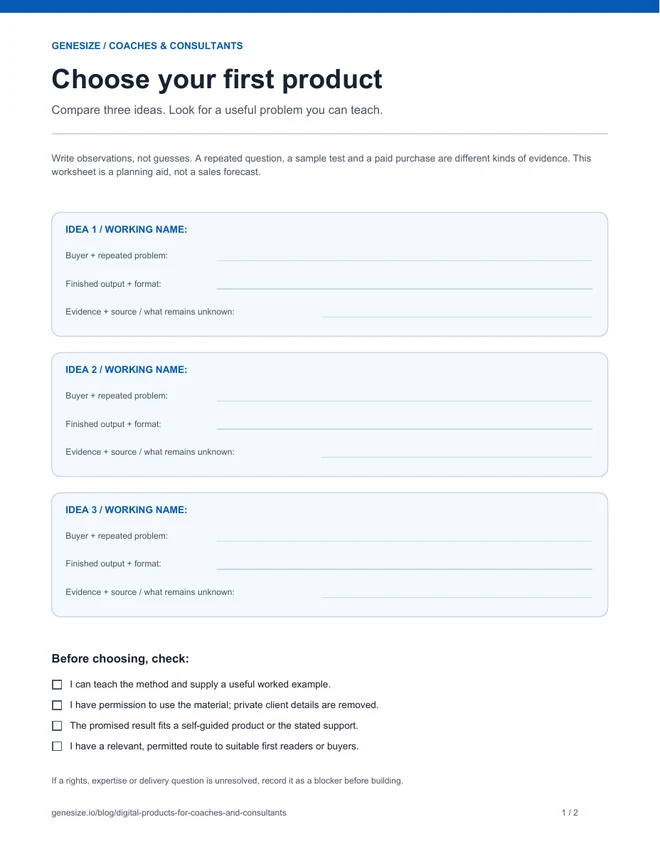
Coaching & Consulting Product Selector
Download the two-page printable PDF and write by hand. To type your answers, use the editable plain-text version in your own editor. The PDF has no interactive form fields.
Download the free product-selection worksheetDownload the editable text worksheet
A separately prepared editorial resource, not a Genesize product export or a finished product to sell. Use and adapt it for your own business and client work. Do not resell or redistribute the blank or modified worksheet as a standalone product.
Digital products for coaches and consultants: FAQs
What digital products can coaches and consultants sell?
Useful options include guides, workbooks, editable templates, checklists and written mini courses. Start with one repeated client problem and name the task the buyer will complete. The best first format is the smallest one that supplies the explanation, examples and practice needed for that task.
What is the best first digital product for a coach?
Start with a question you regularly help suitable clients answer. A focused guide or workbook can be a manageable first test when the method works without personal feedback. If buyers need linked teaching and practice, a short written course may fit better. There is no single product with proven demand for every coach.
Do I need an audience to sell a consulting product?
You need a relevant route to buyers, but it does not have to be a large social following. Existing professional relationships, an opt-in email list, an agreed partner introduction or useful search content can provide a starting route. A software platform does not supply guaranteed traffic or sales.
Should I give away my coaching resource or sell it?
Use a free resource when the aim is a useful introduction or customer education, with a relevant optional next step. Sell a product when it delivers a complete result worth buying on its own. Keep free claims, email permission, paid purchases and qualified inquiries separate when measuring results.
Can I use client work in a digital product?
Use your own methods and material you are allowed to reuse. Do not assume that removing a name makes a client example safe to publish. Check the permissions and agreements that apply, remove confidential details and use clearly labeled fictional examples where appropriate. Seek specific advice if the rights are unclear.
Can Genesize create these products with AI?
Genesize can help draft ebooks, guides, written courses and other written resources using a brief and approved knowledge. You must check the facts, examples, exercises, export and buyer delivery. A Word export, a standard PDF and a separately exported fillable workbook are different files; advertise the format and assets you actually deliver.
Does a digital product replace one-to-one coaching?
Not automatically. A product can explain a repeatable method or help someone prepare for a session. It does not include personal judgment, feedback or ongoing support unless you explicitly provide those services. State the boundaries before purchase and choose a format that can deliver its promise.
How should I price a coaching digital product?
Consider the useful result, the buyer's alternatives, the contents, delivery and support costs. Test a clear price with suitable buyers rather than copying a universal price range. The worked prices in this guide are fictional proposals, not market averages or evidence that customers will pay.
Put one useful part of your expertise to work
Turn a proven method into a clear guide, workbook or written course. Review the content and prepare its offer, storefront and buyer delivery with Genesize.
Start your 14-day trialEligible new subscribers receive 400 total AI credits and up to 3 saved projects during the 14-day trial. Payment method required. Your selected paid subscription starts after the trial and automatically renews unless canceled. Review current plans and allowances before subscribing.